
Reviewed · WALKING TOURS
Best of Buenos Aires Private Walking Tour
Buenos Aires reveals itself one block at a time. This private morning walk brings together 25 or more major sights, from Florida Street and the Kavanagh Building to Recoleta Cemetery and Avenida Alvear. I like the mix of famous landmarks and lesser-known stories, especially the links between Argentina, Britain, France, the church, immigration, and the Malvinas War. The main drawback is simple: this is a lot of ground in about three hours, so you need comfortable shoes and a willingness to keep moving.
I also like the private format, since your guide can explain details at your pace instead of delivering a speech to a large crowd. Guides including Martin, Carlos, Mariano, and others have been praised for clear English, humor, local insight, and an easy walking rhythm. Still, the cemetery portion and the complete route can change with weather, strikes, repairs, city events, or limited time.
In This Review
- Key things to know before you book
- Why this walk works as a first look at Buenos Aires
- Florida Street and the first taste of the city
- Churches, fortunes, and the Kavanagh Building
- The British Clock Tower and the Malvinas memorial
- Plaza San Martín and two extraordinary city palaces
- Barrio Norte, embassy history, and Patio Bullrich
- Recoleta and Avenida Alvear
- Recoleta Cemetery and the stories behind the tombs
- Finishing at La Biela Café
- Guide quality, pace, and group style
- Is $109 per person good value?
- Who should choose this walk?
- Should you book the Best of Buenos Aires Private Walking Tour?
- FAQ
- How long does the tour last?
- Where does the tour begin?
- Where does the tour end?
- Is this a private tour?
- Is an English-speaking guide included?
- Is admission to Recoleta Cemetery included?
- Are meals included?
- Does the tour operate in bad weather?
- Are children charged the full price?
Key things to know before you book
- You cover central Buenos Aires and Recoleta in one morning, finishing near La Biela Café.
- The route links grand architecture with politics and social history, not just postcard views.
- Florida Street, Plaza San Martín, Palacio Paz, and Avenida Alvear provide the strongest architecture-focused sections.
- Recoleta Cemetery receives up to an hour, including Evita’s memorial and stories about unusual graves.
- This is a private activity for your group only, with an English-speaking guide.
- The $109 price includes cemetery admission, but not food, hotel transport, or other entry fees.
Why this walk works as a first look at Buenos Aires
Buenos Aires can feel enormous at first. Its broad avenues, formal squares, grand residences, churches, shopping streets, and separate neighborhoods are easier to understand when a guide connects them into one story.
This route does that well. You begin downtown on Florida Street, move toward Plaza San Martín, then continue through Barrio Norte and Recoleta. Along the way, you see how Argentina’s early wealth shaped its buildings, how European immigration influenced local culture, and how political events still mark the streets.
The tour is advertised as about 2.5 hours, while the practical schedule comes closer to three hours. The start is no later than 10 a.m. at Florida Garden, at Florida 899, outside the café’s corner door near Paraguay Street. Look for the guide holding or wearing a small BA Walking Tours sign.
Because only your group participates, you can ask questions about architecture, Argentine politics, religion, or local customs as you go. That flexibility is one of the clearest reasons to choose this over a large group walk.
More Walking Tours in Buenos Aires
- Buenos Aires Hop-On Hop-Off Bus, Free Walking Tours & Discounts
★ 4.5 · 2,218 reviews - Buenos Aires: La Boca Guided Walking Tour in English
★ 4.8 · 1,587 reviews - Nazis in Buenos Aires: a historical walking tour
★ 4.9 · 193 reviews
Florida Street and the first taste of the city
Florida Street is a smart starting point. It is one of Buenos Aires’ oldest streets and links the foundational area around Plaza de Mayo with Plaza San Martín. Today it is known mainly as a shopping street, but the guide uses it to explain how the downtown area developed.
The opening section is short, yet useful. You get your first sense of the city’s scale and hear stories about the early days of Buenos Aires. I would pay close attention here, since later stops make more sense once you understand how the old center connects to the northern districts.
The pace begins promptly. If you arrive late, you may have trouble catching up, so arrive before the 10 a.m. meeting time.
Churches, fortunes, and the Kavanagh Building
The Basilica del Santísimo Sacramento comes next. Lady Mercedes Anchorena built it for her family in 1916, and the guide uses the church to explain the complicated links among wealth, family power, religion, and social ambition.
This is one of the tour’s recurring themes. Buenos Aires’ grand buildings are not just beautiful façades. They often tell you who had money, who wanted influence, and which families shaped the city.
The Edificio Kavanagh is one of the clearest examples. Rising above Plaza San Martín, this Art Deco skyscraper was once the tallest building in Latin America. Corina Kavanagh, an Irish-descended millionaire, sold two ranches at age 39 to finance the project. Construction took only 14 months.
You do not enter the building, but the exterior is an excellent stop for photographs and architectural context. The building has UNESCO heritage status, and its position above the plaza makes its scale easy to appreciate.
The British Clock Tower and the Malvinas memorial
At the Torre Monumental, you get an unusual lesson in Argentina’s relationship with Britain. The clock tower is a visible reminder of British economic and cultural influence, while the nearby monument to the 1982 South Atlantic War, known in Argentina as the Malvinas War and in Britain as the Falklands War, points to a painful chapter in modern national identity.
The guide explains the contrast between the tower and the memorial. One represents long-standing British involvement in Argentina. The other recalls the conflict and its lasting political weight.
This section is especially useful if you know little about Argentina’s connections with Britain. The tour does not treat architecture as decoration alone. It uses buildings and monuments to explain trade, politics, memory, and national feeling.
A completely different sort of day in Buenos Aires:
- Buenos Aires: Piazzolla Tango Show with Optional Dinner
★ 4.4 · 2,122 reviews - Buenos Aires: City Highlights Guided Tour with Transfer
★ 4.7 · 1,946 reviews - Buenos Aires: Hop-On Hop-Off City Bus Tour
★ 4.2 · 1,855 reviews - Buenos Aires Hop-On Hop-Off Bus and Exclusive Benefits
★ 4.4 · 1,714 reviews
Plaza San Martín and two extraordinary city palaces
Plaza General San Martín has served many roles over time. The area once included a fort, a bullring, and old slave depots. Today, the park centers on the monument to General José de San Martín, Argentina’s leading independence hero.
The guide tells the full story of San Martín and the park’s changing role. This gives you a better sense of how public spaces in Buenos Aires have been reused and reinterpreted.
Palacio Paz is another major stop. Built in 1914 for José C. Paz, a newspaper owner and aspiring president, the mansion used materials imported from France. Its 120 rooms were created for a family of four, which tells you plenty about the era’s elite tastes.
Nearby Palacio San Martín was originally the Anchorena family palace. Its current name came later for political reasons. Mercedes Anchorena, who also commissioned the Basilica del Santísimo Sacramento, is part of the story here.
These residences help explain why Buenos Aires earned its nickname as the Paris of the South. You see French-inspired design, wide streets, formal façades, and the ambitions of families who wanted Argentina to look and feel like a European power.
Barrio Norte, embassy history, and Patio Bullrich
Palacio Estrugamou brings you into Barrio Norte, where Paris-style buildings line elegant streets. The guide uses the neighborhood to discuss immigration from Spain, Italy, France, and Britain, along with Argentina’s rise and later decline between roughly 1880 and 1930.
The route then pauses at the former Israeli Embassy site. A 1992 bombing killed 24 people, and the guide explains the event, its political background, and the difficult questions surrounding justice in Argentina. This is a serious stop, and it adds modern history to a walk otherwise filled with palaces and monuments.
The French Embassy occupies what was originally the Ortiz-Basualdo Palace. Its stories include a visit by Edward VII of England and his American future wife. The emphasis here is on diplomatic ties, aristocratic connections, and the social world that once occupied these residences.
Patio Bullrich offers a particularly good example of changing city life. The building began in 1867 as a British-style auction house for cattle, horses, heirlooms, and other valuable goods. Around 1990, it became an upscale shopping center.
I like this stop because it makes British influence concrete. Instead of hearing only about trade or politics, you see how a building changed from a livestock auction floor into a modern shopping mall.
Recoleta and Avenida Alvear
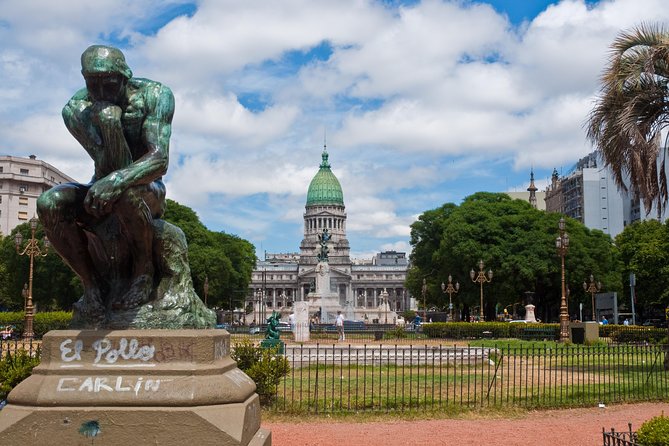
The route continues toward Recoleta, an affluent district first associated with Franciscan Recollect monks. Today, it is known for former palaces, Parisian townhouses, polished shops, and grand public spaces.
Avenida Alvear is the architectural high point before the cemetery. Its mansions reflect the wealth of Argentina’s upper classes during the late 19th and early 20th centuries. The guide also explains immigration and the country’s rise and fall during the period from 1880 to 1930.
This is a good place to look beyond the façades. The buildings are impressive, but the more useful question is how Argentina gained such wealth and why that prosperity did not last in the same way. The tour gives you that economic and social background while you walk.
The Basilica de Nuestra Señora del Pilar is included, with admission covered. Completed in 1732 as part of the Franciscan Recoletos monastery, it is the second-oldest church in Buenos Aires. Its colonial character offers a clear contrast with the later French-style mansions nearby.
Recoleta Cemetery and the stories behind the tombs
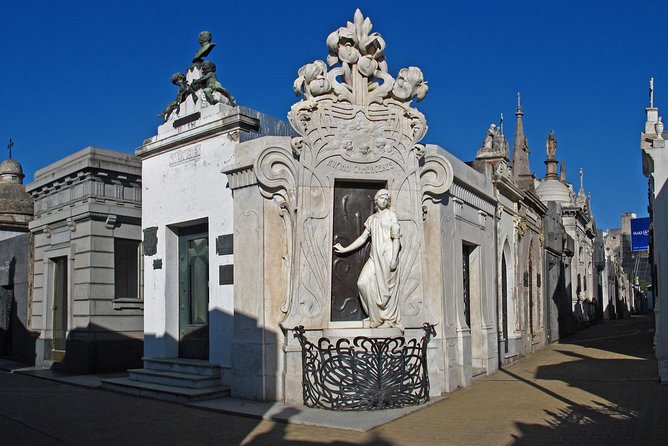
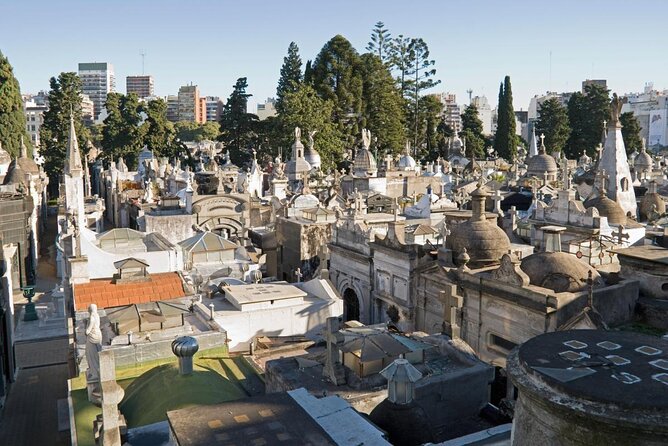
Recoleta Cemetery receives the longest scheduled stop, about an hour. This is not a quick look at the entrance followed by a rushed photograph. The guide takes you through the cemetery’s architecture, famous residents, family stories, and unusual details.
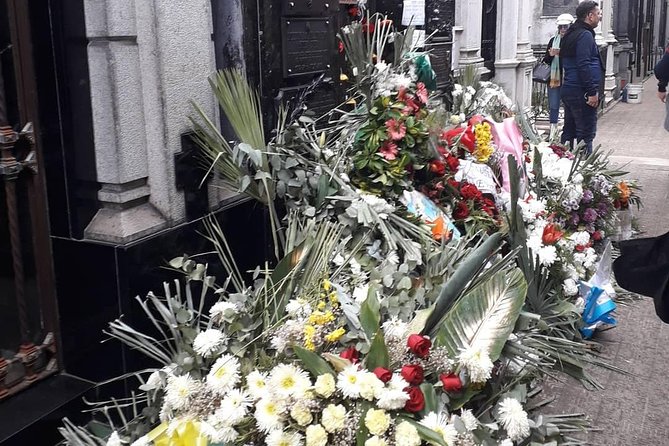
Evita Perón and her memorial are central to the visit. You hear her story in the setting where Argentine political history, celebrity, class, and national memory meet.
The route also includes stories about Rufina Cambaceres, Tiburcia Domínguez, Admiral Brown, the wealthy Leloir family, General Guido, and Liliana Crociatti. These accounts give the cemetery a human scale. The mausoleums may look formal, but the stories involve ambition, tragedy, family conflict, and odd personal choices.
The cemetery section can also touch on the old monastery and cultural center, Bourdelle’s monument to Alvear, the Palais de Glace and the growth of tango, immigration through the port, the National Fine Arts Museum, the National Library, and nearby districts such as Palermo Chico and Loma Mitre. The exact coverage depends on time and conditions.
One important practical point: the complete cemetery visit is described as part of the route, but one past experience ended at Recoleta without entering the cemetery. City conditions and timing can affect the final sequence, so confirm the expected route when you meet your guide.
Finishing at La Biela Café
The walk ends outside La Biela, a landmark café on Avenida Quintana. Your guide explains the café, Recoleta, and nearby attractions before leaving you to choose what to do next.
This is a useful ending rather than an awkward drop-off. Recoleta is one of Buenos Aires’ main restaurant and attraction districts, so you can continue exploring, stop for a drink, or arrange your own onward transport.
The tour does not include hotel pickup or return transport. One past experience found the final area far enough from the hotel to require another long walk, so plan to use public transportation or a taxi if you are not staying nearby.
Guide quality, pace, and group style
The strongest part of this experience is the guide. Martin receives repeated praise for his humor, strong English, and ability to explain Argentine social, economic, and political life. Carlos is described as amusing and well informed about architecture, while Mariano is praised for showing less obvious parts of the city.
The best guides on this route do more than name buildings. They explain why a family built a palace, how immigration affected Buenos Aires, and what a monument says about national identity. That approach turns a sightseeing walk into a useful introduction to Argentina.
The pace is usually manageable, but this remains a solid walk. One person described it as roughly 2.5 hours of continuous walking, while another found the pace easy and not rushed. Expect some variation depending on the guide and the size of your group.
You do not need to be exceptionally fit, but you should be comfortable walking for several hours with short stops. Wear supportive shoes. The tour operates in rain or shine, and there is no promise that every stop will receive equal time.
Is $109 per person good value?
At $109 per person, this is not the cheapest way to see Buenos Aires. The value depends on what you want from the morning.
You are paying for a private English-speaking guide, a route that crosses several important districts, cemetery admission, and a large amount of context in a short period. If you tried to research and connect 25 or more landmarks on your own, you would spend much of your first day finding the places rather than understanding them.
The private format improves the value for couples, families, or small groups. You can ask questions, adjust the discussion, and avoid waiting for a large party. The price is harder to justify if you mainly want quick photographs or prefer to explore slowly inside museums and churches.
Food is not included. Neither is hotel transport. Children aged eight and under are free when accompanied by an adult, which can make the cost more attractive for families.
Who should choose this walk?
I would choose this tour for a first morning in Buenos Aires, especially if you want a strong overview before exploring on your own. It suits people who enjoy architecture, political history, family stories, churches, and city planning.
It is also a good choice for anyone with limited time. The route covers downtown, Plaza San Martín, Barrio Norte, and Recoleta without requiring you to organize several separate outings.
I would be more cautious if you dislike long walks, want extended time inside each building, or prefer a slow café-and-shopping morning. The itinerary is ambitious, and the guide’s storytelling may sometimes compete with quiet time for photographs.
Booking at least several weeks ahead is sensible. This experience is often reserved about 59 days before the date, which suggests that popular mornings can fill well in advance. Free cancellation is available until 24 hours before the start time. Changes or cancellations inside that window are not accepted for a refund.
Should you book the Best of Buenos Aires Private Walking Tour?
Book it if you want a fast, story-filled introduction to Buenos Aires and value a private guide who can explain what you are seeing. The strongest reasons are the wide range of neighborhoods, the excellent architectural contrasts, the serious political context, and the detailed Recoleta Cemetery visit.
Skip it if you want a short, relaxed stroll or guaranteed time at every stop. The route covers a great deal, and the final itinerary can shift with city conditions.
For most first-time visitors who enjoy walking, I think the tour offers a useful foundation. By the time you reach La Biela, you should have a clearer map of Buenos Aires and several ideas for places to revisit at your own pace.
FAQ
How long does the tour last?
The experience lasts approximately three hours, although it is also described as a 2.5-hour walking tour.
Where does the tour begin?
It begins at Florida Garden, Florida 899, Buenos Aires. Meet outside the café’s corner door near Paraguay Street, no later than 10 a.m.
Where does the tour end?
The walk ends outside La Biela Café at Avenida Pres. Manuel Quintana 596 in Recoleta.
Is this a private tour?
Yes. Only your group participates in the activity.
Is an English-speaking guide included?
Yes. A professional English-speaking guide is included.
Is admission to Recoleta Cemetery included?
Yes. Cemetery admission is included in the tour price.
Are meals included?
No. Meals are not included.
Does the tour operate in bad weather?
Yes. The tour operates rain or shine, although weather and other city conditions may affect the full route.
Are children charged the full price?
Children aged eight and under are free when accompanied by an adult.
Latest additions in Buenos Aires
- Buenos Aires: 7 Hour Small Group “BA 101” Walk★ 5.0 · 3 reviews
- Unique Tigre and Delta Private Day Cruise Navegation★ 5.0 · 3 reviews
- Buenos Aires: Customizable City Tour in Polish★ 4.7 · 3 reviews
- Buenos Aires After Dark: A City Lights & Sunset Experience★ 5.0 · 3 reviews
- Tango Show at El Querandi with optional Dinner★ 4.2 · 3 reviews
- Velez Sarsfield Football Match★ 5.0 · 3 reviews
- Caminito, La Boca: vibrant neighborhood★ 5.0 · 3 reviews
- Café de los Angelitos – Traditional Night in Buenos Aires★ 4.8 · 3 reviews
Walking Tours, compared.
Nazis in Buenos Aires: a historical walking tour
Read our review →
La Docta Free Walking Tour “Córdoba La Antigua”.
Read our review →
Buenos Aires Walking Tour with Local Guide and Optional Rooftop
Read our review →
Browse the lists this tour appears in