
Reviewed · USHUAIA TOURS
Exploring Ushuaia: Double Decker Bus Tour
Ushuaia rewards a quick first look. This short double-decker ride covers historic buildings, memorials, hillside viewpoints, neighborhoods, and the harbor in about 70 minutes. I especially like the broad sweep of the route and the chance to see parts of town that are awkward to reach on foot, including Monte Gallinero, the Pipo River area, and Laguna del Diablo.
The city views are the main prize, particularly from the higher parts of the route and the photo stop near Laguna del Diablo. I also like the low price of $32 for a compact introduction. The trade-off is that this is an overview, not a detailed guided visit. Commentary can be brief or hard to hear when the upper deck gets noisy, and the bus route or museum stop may not match every published description.
In This Review
- Key points to know before you go
- Why this short ride works in Ushuaia
- The first stops: government, school, and chapel
- Malvinas Memorial and the First Cemetery
- Science, universities, and the high views
- Pipo River and the road built by prisoners
- Laguna del Diablo and the best photo break
- Saint Christopher, the End of the World Museum, and the harbor
- What the commentary is really like
- Comfort, timing, and the $32 price
- Who should book this Ushuaia tour?
- Final call: book it for orientation, not depth
- FAQ
- How long does the Ushuaia Double-Decker Bus Tour last?
- Where does the tour begin?
- Where does the tour end?
- How much does the tour cost?
- Does the tour include hotel pickup?
- Is the tour offered all year in a double-decker bus?
- Is English available?
- Are other languages available?
- What happens if bad weather cancels the tour?
Key points to know before you go

- About 70 minutes: A useful orientation ride if you have only a short time in Ushuaia.
- A broad 15-kilometer loop: The bus links central landmarks with hill roads, newer neighborhoods, and scenic overlooks.
- Two useful photo stops: You get time to take pictures at Laguna del Diablo and a high viewpoint with views toward the city and harbor.
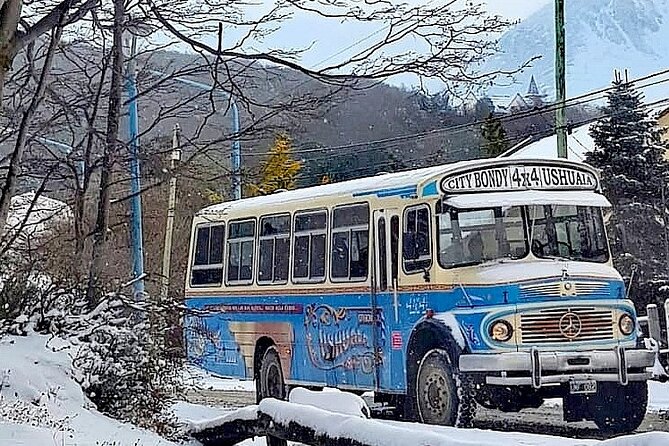
- Season matters: The open-style double-decker operates from October through April. In winter, the experience changes to a Bondi 4×4 and operates in Spanish only.
- Audio options: Summer departures include English and Spanish support, with German, Chinese, Russian, Italian, French, and Portuguese audio available through the seat jacks with your own headphones.
- Small group size: The stated maximum is 20 people, though the upper deck can still feel cramped on an older bus.
Why this short ride works in Ushuaia
Ushuaia is compact in its central streets, but it rises quickly into steep hills. That makes the bus useful. You can walk the waterfront and central blocks easily, yet reaching the university, Monte Vigía, the older cemetery, and the upper neighborhoods takes time and effort.
I would use this ride early in a stay, not as the main activity of a visit. It gives you a mental map before you choose where to return on foot. You will see the city’s maritime identity, its prison-era past, its memorials, and its modern scientific institutions in one pass.
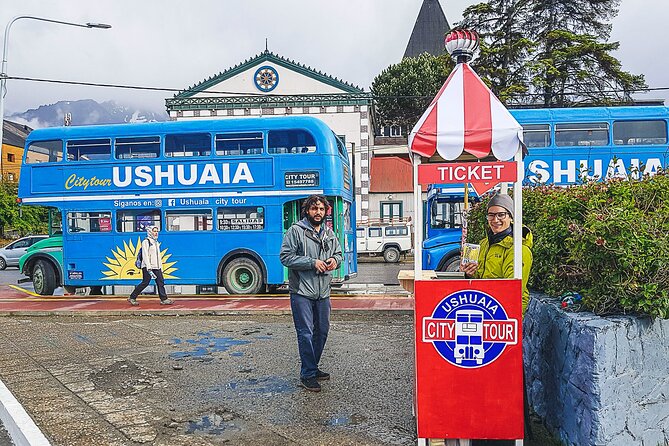
The trip begins at Civic Plaza, near Avenida Maipú 420 to 498. The bus returns to the same meeting point, so you do not need to arrange a separate ride back. Hotel pickup is not included, and the service is close to public transportation.
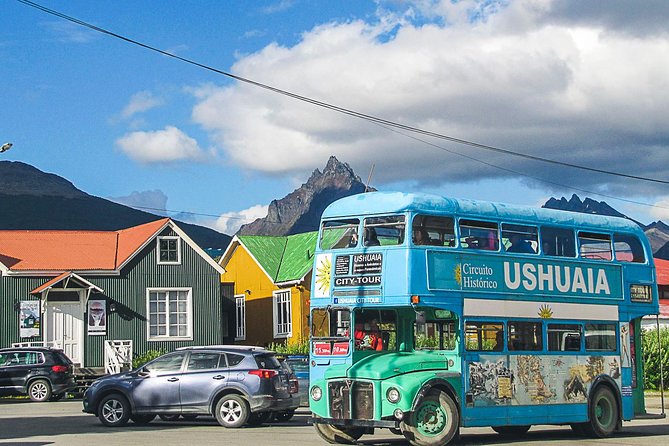
The bus usually provides a recorded narration in English and Spanish, along with music. Other languages can be selected through equipment at each seat. Bring your own headphones with a standard jack if you want to use those options. Some departures also have a staff member on board, but do not expect a private guide beside you explaining every building.
Other days out in Ushuaia that people book on the same trip:
- Ushuaia: National Park & Train of the End of the World Tour
★ 4.5 · 811 reviews - Ushuaia: Penguin Watching Tour by Catamaran
★ 4.5 · 439 reviews - Ushuaia: Catamaran Sailing to Penguin Island
★ 4.4 · 436 reviews
The first stops: government, school, and chapel
The route opens near the Antigua Casa de Gobierno, or Old Government House. This is a sensible starting point because Ushuaia’s early civic story is tied to this part of town. The first school and the First Chapel add two more pieces to that picture: education and religion helped form the early settlement.
You are not getting a full museum visit here. The bus gives you a short look and spoken context, with roughly 15 minutes assigned to this opening section. That makes it useful for orientation, but anyone hoping to step inside several buildings will find the pace too quick.
The stop at the Lucinda Otero house lasts about five minutes. The house is included for its local architecture and connection to the city’s spiritual life. It is a small stop, so think of it as a passing detail that adds texture to the route rather than a major attraction.
This early part of the trip is strongest when you pay attention to how the city developed. Ushuaia is not just a port at the end of the road. Its public buildings, homes, schools, and religious sites show how a remote settlement became a functioning city.
Malvinas Memorial and the First Cemetery
The Malvinas Memorial is one of the route’s most serious stops. It honors Argentine combatants from the Falklands, or Malvinas, War. Even if you know little about the conflict, the monument gives you a clear reminder of how national memory shapes public spaces in Argentina.
The visit is scheduled for about 10 minutes. That is enough for a quick look and some explanation, but not a long historical discussion. I would listen carefully here, since the subject carries emotional weight and the audio may not pause for long.
The First Cemetery follows with a quieter mood. It offers a short pause to consider the people who lived and died in the early city. The stop lasts around five minutes, so the value is less about seeing a grand attraction and more about connecting Ushuaia’s present streets with its earlier residents.
These two stops help prevent the tour from becoming only a scenic drive. You get monuments and graves, not just pretty views. Still, the limited time means you should not expect detailed stories about individual people.
Science, universities, and the high views
The bus continues toward CADIC, the National University of Tierra del Fuego, Monte Gallinero, and Monte Vigía. This is one of the more useful sections for understanding modern Ushuaia. The university and research center point to the city’s scientific role, while the hills explain why the views open so dramatically above the center.
The route does not turn these institutions into formal visits. You will see them from the bus and hear an explanation. The real reward comes at the higher points, where the city, harbor, and surrounding scenery spread below you.
Several people find this the best part of the ride. The bus climbs steep roads, and the views can be impressive even in poor weather. On clear days, bring a camera and keep your phone ready. On wet or windy days, the upper deck may be uncomfortable, and the windows or open sides can make photography tricky.
The bus can also feel bumpy on the top deck. Those steep roads are part of the reason to take the tour, but they are not ideal for anyone wanting a smooth ride. I would choose a lower seat if you are sensitive to motion, then move upstairs only if conditions are comfortable.
A completely different sort of day in Ushuaia:
- Ushuaia: Beagle Channel & Sea Wolves Island Catamaran Cruise
★ 4.6 · 433 reviews - National Park and Train Trip End of the World Guided Tour
★ 4.0 · 414 reviews - Ushuaia: Beagle Channel and Penguin Island
★ 4.6 · 318 reviews - From Ushuaia: Tierra del Fuego Emerald Lagoon Trekking Tour
★ 4.9 · 271 reviews
Pipo River and the road built by prisoners
The route then leaves the central streets and passes the Pipo River and newer neighborhoods. This section shows the city beyond the postcard center. You see ordinary residential areas and get a better sense of how Ushuaia has expanded.
The bus next reaches Camino de los Presos, the Prisoners’ Road. This is an important historical reference because Ushuaia’s former prison shaped the city’s early identity and development. The road helps explain the connection between the penal colony, forced labor, and the growth of local infrastructure.
The stop is short, about five minutes. That is enough to understand the basic story, but not enough for a careful study of the prison system or the lives of the people held there. If prison history is your main reason for visiting Ushuaia, plan a separate visit to the prison and maritime museum area rather than relying on this bus ride.
There is also a practical warning here. The route has not always included every museum stop described in older trip details. One account specifically expected a stop at the Maritime and Prison Museum but found that the bus did not go there. Confirm the current route before booking if that museum is essential to your plans.
Laguna del Diablo and the best photo break
Laguna del Diablo is the one clear stop where you get off for a break and photographs. The scheduled time is about 10 minutes, which is short but much better than taking pictures through a moving window.
The pond itself may not impress everyone equally. For me, the value depends on the weather and your expectations. Some people find the stop modest, while others enjoy the quiet setting and the change from the busy central streets. The views from the surrounding hills are often more memorable than the pond.
You then pass through the Barrio de los Italianos and by the local hospital. These are not major sightseeing stops, but they help fill out the picture of daily Ushuaia. You see more of the residential city, not just monuments selected for visitors.
Bring a rain jacket. Ushuaia’s weather can change quickly, and the outdoor stop is less enjoyable if you are caught without protection. The tour requires good weather, and a cancellation caused by poor conditions is handled with a new date or a full refund. The experience itself cannot otherwise be canceled or changed for a refund.
Saint Christopher, the End of the World Museum, and the harbor
Near the waterfront, the bus includes the Saint Christopher shipwreck and the End of the World Museum area. Saint Christopher is a distinctive maritime sight, and it fits Ushuaia’s identity as a port connected to ships, exploration, and remote southern routes.
The End of the World Museum adds another layer to the city’s story, linking local history with Indigenous culture, exploration, settlement, and natural science. The scheduled visit is only about five minutes, so you are mainly getting an outside look and a short explanation.
Do not confuse this brief stop with a museum visit. The tour does not provide enough time to work through exhibits. If you want a serious look at Ushuaia’s past, return later and pay for admission separately.
The ride ends near the Naval Pier and the Fournier Monument. These final points bring the tour back to the sea and to the people who helped develop Ushuaia’s maritime life. Finishing here makes sense: the city’s port is central to its identity, and the waterfront is also one of the easiest areas to explore on foot after the bus returns.
What the commentary is really like
The narration is generally clear and useful for a quick introduction, especially when the bus is not noisy. It covers the city’s history and points out buildings, neighborhoods, and views as you pass them.
The main weakness is depth. Some sections offer only a few facts, and a recorded track cannot adjust to your questions or linger when something catches your attention. Music plays as part of the presentation, which some people enjoy and others may find distracting.
The upper deck can also create a sound problem. Passengers talking nearby may make the recording difficult to hear, and there may not be a staff member upstairs to quiet the group. If the commentary matters to you, sit near the audio equipment, bring headphones, and consider the lower deck if the bus is crowded.
Summer service includes English and Spanish. In winter, the Bondi 4×4 version operates in Spanish only. The other seat-based audio choices are useful, but you need your own headphones unless you purchase a pair locally.
Comfort, timing, and the $32 price
At $32 per person, I see this as a reasonable orientation ride rather than a bargain attraction. You are paying for transport over a wide route, scenic access to the hills, a small group cap of 20 people, and a short explanation of the city.
The value is strongest if you have only one free hour, poor walking conditions, limited mobility, or a rainy day when you still want to see more than the waterfront. It is also handy for cruise passengers who need a compact activity close to the center.
The value is weaker if you have several days in Ushuaia and are comfortable walking, using local transport, or hiring a taxi to visit specific sights. The bus does not give you much time at each stop, and some parts of the route may feel like a slow drive through neighborhoods.
The older bus adds charm, but it is not luxury transport. The upper deck can be cramped, the stairs are narrow, and the ride can be bumpy on steep roads. Departures are offered at several times, which helps you fit the trip around other plans, but do not treat it like a frequent hop-on, hop-off service. Buses may not come around often enough for easy independent hopping, and a full bus can arrive at a stop with limited room.
Who should book this Ushuaia tour?
I would recommend it to first-time visitors, cruise passengers, couples, solo visitors, and anyone who wants a quick map of the city before choosing longer activities. It is especially useful if you want to reach the hills without arranging a taxi.
You should also consider it if weather is uncertain. A warm bus and a short route can be a pleasant way to see Ushuaia when rain makes walking less appealing, though you still need a coat for the outdoor stop.
I would skip it if your main goal is detailed history, museum time, or a close visit to the prison. You will get an introduction, not a study. I would also skip it if the $32 price feels high for a one-hour ride and you have enough time to explore the central area on your own.
Final call: book it for orientation, not depth
This double-decker tour earns its solid reputation through good views, broad coverage, and a manageable length. The ride gives you more than a central walking loop, including the hills, university area, Pipo River, Prisoners’ Road, and residential districts.
Book it early in your Ushuaia stay if you want a useful overview and a low-effort way to reach high viewpoints. Go in with realistic expectations: the commentary may be recorded, the stops are brief, and route details can change. If you want the deepest history or a guaranteed museum visit, choose a longer guided activity or visit those museums separately.
FAQ
How long does the Ushuaia Double-Decker Bus Tour last?
The tour lasts approximately 1 hour and 10 minutes.
Where does the tour begin?
It begins at Civic Plaza on Avenida Maipú, between numbers 420 and 498, in Ushuaia.
Where does the tour end?
The activity ends back at the original meeting point.
How much does the tour cost?
The listed price is $32 per person.
Does the tour include hotel pickup?
No. Hotel pickup and drop-off are not included.
Is the tour offered all year in a double-decker bus?
No. The double-decker service operates from October through April. During winter, it operates in a Bondi 4×4 in Spanish only.
Is English available?
English and Spanish support is included in summer. In winter, the tour operates in Spanish only.
Are other languages available?
German, Chinese, Russian, Italian, French, and Portuguese audio is available at the seats. You need your own headphones with a suitable jack.
What happens if bad weather cancels the tour?
If poor weather causes a cancellation, you are offered another date or a full refund. Otherwise, the experience is non-refundable and cannot be changed.
Latest additions in Ushuaia
- USHUAIA: LANDSCAPES AND DELIGHTS – CITY TOUR★ 4.5 · 3 reviews
- Ushuaia: Tour: Beagle Channel Navigation★ 4.7 · 3 reviews
- Emerald Lagoon Helicopter seeing★ 5.0 · 3 reviews
- Trekking Esmeralda Lagoon★ 4.8 · 3 reviews
- Full Day Trip to Tierra del Fuego National Park★ 4.2 · 3 reviews
- Private Experience “Tierra del Fuego” National Park★ 4.7 · 3 reviews
- From Ushuaia: Private Fagnano Lake 4WD Tour★ 5.0 · 4 reviews
- Tierra del Fuego National Park★ 4.5 · 4 reviews
Ushuaia Tours, compared.
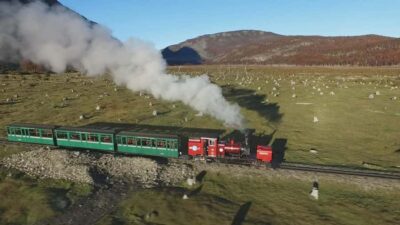
National Park & Train of the End of the World Tour
Read our review →


Beagle Channel & Sea Wolves Island Catamaran Cruise
Read our review →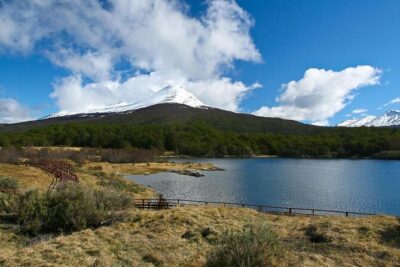
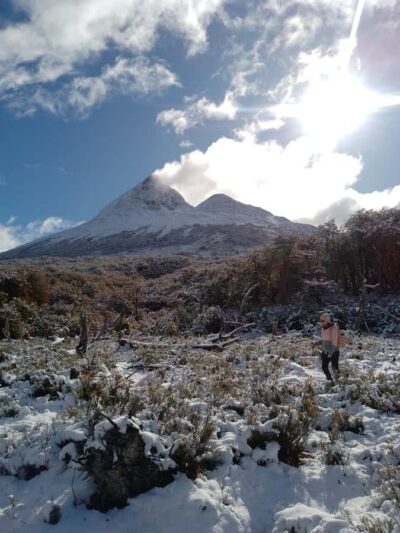
National Park and Train Trip End of the World Guided Tour
Read our review →

National Park, Train, and Beagle Channel Navigation
Read our review →Browse the lists this tour appears in